

1. Purpose and audience
This page outlines the latest version of the Health-RI metadata schema for the National Health Data Catalogue, detailing the classes and properties involved and offering usage notes for data holders tasked with filling in the schema. It addresses the schema’s design and application but excludes discussion on the National Health Data Catalogue and its onboarding process (these are described here). Please also visit Confluence for general information about the metadata schema and metadata mapping. Some features described in this specification may not yet be available in the National Health Data Catalogue frontend.
This documentation aims at a technical audience tasked with implementing the metadata schema and stakeholders interested in a detailed understanding of the Health-RI metadata schema. For any further questions or comments, please contact Health-RI via the Health-RI ServiceDesk or via servicedesk@health-ri.nl.
2. Introduction
2.1. Scope and Current State of the Schema
Version 2.1.0 of the Health-RI metadata schema defines metadata for describing health data resources in the National Health Data Catalogue. It draws on DCAT-AP NL and the OPEN variant of the HealthDCAT-AP draft snapshot taken on December 16, 2024, with documented Health-RI-specific adaptations.
This version expands Dataset descriptions with data domains (edam:has_topic), measurement techniques (schema:measurementTechnique), health conditions of interest (hri:healthConditionOfInterest), and anatomical coverage (hri:anatomicalLocationCovered). It also adds alternative dataset names, landing pages, provenance statements, and CSV on the Web (CSVW) variable descriptions using Table Group, Table, and Column.
Selected property requirements are relaxed compared with version 2.0.3. The class and property tables in this specification define the applicable ranges, cardinalities, and usage requirements for version 2.1.0. An overview of the changes is available in the model changelog.
CSVW variable descriptions are included for testing purposes. Their current implementation status in the National Health Data Catalogue is explained in the CSVW Variables section.
2.2. Used Prefixes
| Prefix | Namespace IRI |
|---|---|
| adms | http://www.w3.org/ns/adms# |
| csvw | http://www.w3.org/ns/csvw# |
| dcat | http://www.w3.org/ns/dcat# |
| dcatap | http://data.europa.eu/r5r/ |
| dct | http://purl.org/dc/terms/ |
| dpv | https://w3id.org/dpv# |
| pd | https://w3id.org/dpv/pd# |
| dqv | http://www.w3.org/ns/dqv# |
| edam | http://edamontology.org/ |
| eli | http://data.europa.eu/eli/ontology# |
| foaf | http://xmlns.com/foaf/0.1/ |
| hri | https://w3id.org/health-ri/metadata-vocabulary# |
| oa | http://www.w3.org/ns/oa# |
| owl | http://www.w3.org/2002/07/owl# |
| prov | http://www.w3.org/ns/prov# |
| rdf | http://www.w3.org/1999/02/22-rdf-syntax-ns# |
| rdfs | http://www.w3.org/2000/01/rdf-schema# |
| schema | https://schema.org/ |
| skos | http://www.w3.org/2004/02/skos/core# |
| spdx | http://spdx.org/rdf/terms# |
| time | http://www.w3.org/2006/time# |
| vcard | http://www.w3.org/2006/vcard/ns# |
| xsd | http://www.w3.org/2001/XMLSchema# |
| healthdcatap | http://healthdataportal.eu/ns/health# |
3. Overview and Diagram
An overview of the Health-RI metadata schema is presented in the Unified Modeling Language (UML) diagram below. This UML diagram showcases primary classes (entities), excluding detailed definitions such as rdfs:label and rdfs:comment. Each block represents a class and lists its attributes (properties). Where properties reference another class, their range is displayed in pink font.
If a class is linked to another class by an arrow with a hollow triangular arrowhead, it inherits all properties from the other class (e.g., dcat:Dataset inherits from dcat:Resource). Other arrows represent relationships, including their types (e.g., dcat:Dataset connects to a dcat:DatasetSeries via dcat:inSeries), along with cardinalities (e.g., dcat:Dataset connects to zero or more dcat:DatasetSeries). Mandatory relationships are marked with dark labels, while recommended relationships use a lighter color.
The UML diagram separates main classes from supporting classes. While relationships between main classes are indicated by arrows, supporting class relationships (except for those between the CSVW Table Group, Table, and Column classes) are not visually connected via arrows to maintain clarity in the diagram. Instead, they can be deduced from the pink-colored property ranges listed per class.
Properties derived from draft HealthDCAT-AP (mostly within the dcat:Dataset class) are marked blue.
A tabular overview of all classes and properties—including their range, cardinality, controlled vocabulary (if applicable), and usage notes—is provided below. A reference sheet containing this information can be found here. This sheet also documents property histories (compared to v1 of the Health-RI metadata schema) and specifies the origins of new constraints (whether they stem from DCAT-AP v3, DCAT-AP NL, or HealthDCAT-AP).
3.1. UML Class Diagram v2.1.0
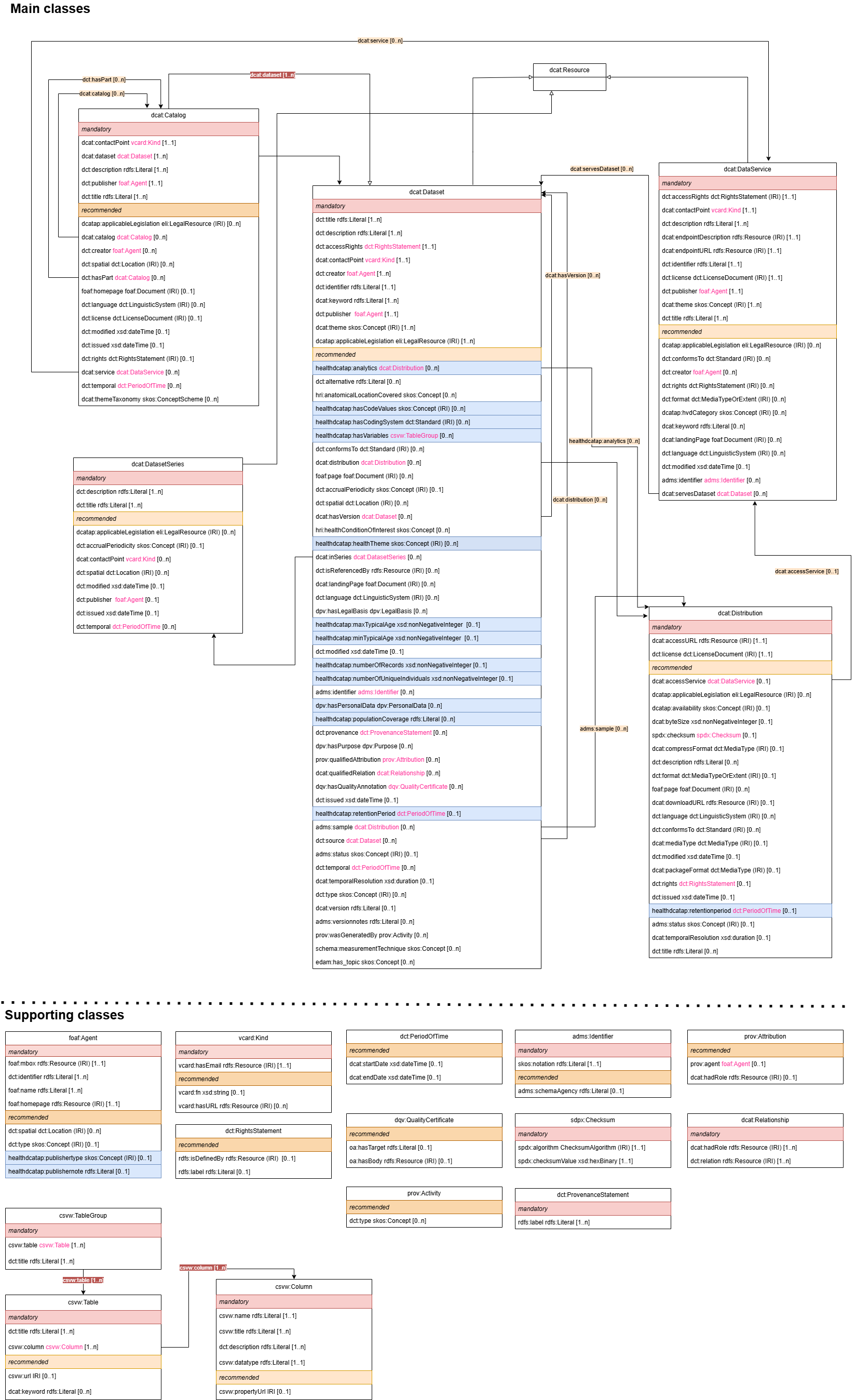
Usage directions for the properties and their associated constraints that apply in the context of this profile, and the range of properties, are listed below.
4. Permanent Urls
To support long-term FAIR (Findable, Accessible, Interoperable, and Reusable) access to Health-RI metadata schema resources, we provide persistent URLs using the W3ID system. These permanent identifiers improve the findability and accessibility of the related artifacts. The following links distinguish the published specification from the metadata model and its SHACL sources:
Specification
-
Published specification: w3id.org/health-ri/metadata/docs
-
Documentation repository: w3id.org/health-ri/metadata/docs/git
Metadata model and SHACL resources
-
Model repository: w3id.org/health-ri/metadata/git
-
SHACL source files: development branch
Metadata model releases
-
Latest model release: w3id.org/health-ri/metadata/releases/latest
-
All model releases: w3id.org/health-ri/metadata/releases
-
Specific model release:
-
Use the following pattern to reference a specific versioned model release:
https://w3id.org/health-ri/metadata/releases/{version}. -
For example: w3id.org/health-ri/metadata/releases/v1.0.1
-
Project Homepage
Main page: w3id.org/health-ri/metadata
4.1. Versioning and releases
Version numbers communicate compatibility:
-
Major: backward-incompatible changes that may require updates to existing metadata or implementations.
-
Minor: backward-compatible extensions and improvements.
-
Patch: backward-compatible technical corrections or documentation improvements that preserve the schema’s meaning and validation outcomes.
Draft versions may change during development. A release candidate (such as -rc.1) is feature frozen for testing and may receive bug fixes before final release.
Major and minor releases undergo conceptual review, technical validation, and implementer testing to assess semantic correctness, consistency between the specification and validation shapes, and practical usability before approval.
4.2. Class Structure
The Health-RI metadata schema builds on DCAT-AP 3.0, which defines a set of classes and properties for describing datasets, services, and related resources. To make the model easier to apply (and interoperable) across catalogues, the schema organizes its structure around two types of classes: Main Classes and Supportive Classes.
-
Main Classes – the core entities of the catalogue.
-
Supportive Classes – contextual entities that provide detail to the main classes.
Main classes in this structure:
-
Catalog
-
Dataset
-
Data Service
-
Dataset Series
-
Distribution
Supportive classes in this structure:
-
Agent
-
Kind
-
Attribution
-
Checksum
-
Identifier
-
Period of time
-
Relationship
-
Quality certificate
-
Activity
-
Provenance Statement
-
CSVW (Variables)
The main classes and supportive classes together form the Health-RI metadata schema.
Please take into consideration:
-
Certain properties (e.g.
dct:publisher,dct:creator,dcat:contactPoint) in several of the main classes refer to the supporting classes (e.g.foaf:Agent,vcard:Kind). When used, these properties refer to instances of the specific supporting classes. For example,dct:publisheranddct:creatorcan refer to differentfoaf:Agentinstances (organisation vs. person). -
It is possible that not all main classes of the metadata schema are necessary to describe your data or the structure of your data. For example, DataService or DatasetSeries might not apply to all datasets described/onboarded in the National Health Data Catalogue.
-
The power of DCAT is that it is flexible in use, giving a data holder the ability to reflect the structure of their data by using the different classes.
-
We aim to collect mapping examples from different data sources here. Currently, this collection only holds mapping examples to v1 though.
-
Please visit Confluence for general information about the metadata schema and metadata mapping.
4.3. Usage Notes on Schema / Mapping
Supportive classes are included because they form the range of properties used by the main classes or by other supportive classes [additional requirements to properties for the entity]. They enrich the main classes which are the core entities in the catalogue. Both structures are further divided into mandatory properties for conformance and recommended properties for richer metadata.
The separation described above helps modularize metadata and makes it easier to reuse supporting elements across multiple datasets or services. It helps users to use those classes more easily. To apply it:
-
Start with main classes -> Identify the datasets, services, and distributions you need to describe.
-
Link supportive classes –> Use them wherever the schema specifies a property range (e.g., publisher → Agent).
-
Always fill mandatory properties –> Support metadata validity and interoperability.
-
Check controlled vocabulary requirements -> For each property, consult Section 7 to determine whether a MUST, AT LEAST 1, or MAY requirement applies, as controlled vocabularies support consistent and interoperable values.
-
Add recommended properties where possible –> Improve FAIRness and increase the overall maturity of your metadata.
-
Reuse supportive entities –> E.g. if the same Agent or Identifier appears in multiple records, reference it rather than duplicating it.
The following sections describe each class in detail, including its role in the schema, its mandatory and recommended properties, and examples of how to populate them.
5. Main Classes
Main Classes represent the core entities of the data catalogue.
5.1. Mandatory main classes
5.1.1. Catalog
| Class name | HealthDCAT-AP Definition | Usage Note | URI |
|---|---|---|---|
| Catalog | A catalogue or repository that hosts the Datasets or Data Services being described. | A catalog that is listed in the National Health Data Catalogue and contains one or several datasets and may also contain data services. Used to describe a bundle of datasets (and other resources) under a single title, for example, a collection. | dcat:Catalog |
| Property label | Definition | Property URI | Range | Cardinality | Usage note |
|---|---|---|---|---|---|
| applicable legislation | The legislation that is applicable to this resource. | dcatap:applicableLegislation | eli:LegalResource (IRI) | 0..n | N.A. |
| catalogue | A catalogue that is listed in the catalogue. | dcat:catalog | dcat:Catalog | 0..n | For certain research projects, multiple catalogues may need to be organised in a nested manner. This property serves to connect the different catalogues with each other. |
| contact point | Relevant contact information for the catalogued resource. | dcat:contactPoint | vcard:Kind | 1 | This property points to a contact point that can answer questions about the dataset. Details on how to describe these are provided under the vcard:Kind class. Whenever possible, use general contact information (for example, from a department) instead of the contact information of an individual. |
| creator | An entity responsible for making the resource. | dct:creator | foaf:Agent | 0..n | The creator is the entity responsible for making the resource. According to Dutch databank and copyright law, this is in most cases the organisation/employer bearing investment risk, instead of an individual (e.g. an individual researcher). Therefore, in many cases, this might be the same Agent as the dct:publisher: the organisation (not a department or subdivision of the organisation) where the catalogue was created. If there are multiple (collaborating) organisations involved in data creation, all of them can be stated as dct:creator, as the model allows more than one creator. Note that the Health-RI model diverges from DCAT-AP NL here, which reduces the maximum number of creators to 1. The Health-RI model allows the specification of multiple creators of a catalogue. |
| dataset | A dataset that is listed in the catalogue. | dcat:dataset | dcat:Dataset | 1..n | Each catalogue contains one or more datasets. This property serves to link datasets to a catalogue. Therefore, a dataset is always contained inside a catalogue. |
| description | An account of the resource. | dct:description | rdfs:Literal | 1..n | Briefly describe the catalogue and what it contains. You can repeat this in multiple languages. |
| geographical coverage | Spatial characteristics of the resource. | dct:spatial | dct:Location (IRI) | 0..n | The EU Vocabularies Named Authority Lists MAY be used for continents, countries and places that are in those lists. If a particular location is not in any of those lists, GeoNames URIs MAY be used. For districts or neighbourhoods in NL, the Dutch vocabulary can be used. Controlled vocabulary: https://vocabs.cbs.nl/nl/ https://publications.europa.eu/resource/authority/continent https://publications.europa.eu/resource/authority/country https://publications.europa.eu/resource/authority/place http://sws.geonames.org/ |
| has part | A related resource that is included either physically or logically in the described resource. | dct:hasPart | dcat:Catalog | 0..n | Use this property to establish another catalogue in this catalogue. Note that deeply nested structures should be avoided, and cannot currently be displayed in the National Health Data Catalogue. |
| home page | A homepage for some thing. | foaf:homepage | foaf:Document (IRI) | 0..1 | The home page of the catalogue, if available. |
| language | A language of the resource. | dct:language | dct:LinguisticSystem (IRI) | 0..n | The value of this property must be an IRI from the provided controlled vocabulary. For example: http://publications.europa.eu/resource/authority/language/NLD Controlled vocabulary: http://publications.europa.eu/resource/authority/language |
| licence | A legal document giving official permission to do something with the resource. | dct:license | dct:LicenseDocument (IRI) | 0..1 | The licence under which the catalogue (with its resource description) is made available. The licences for Distributions and Data Services are not specified here. They are specified in the licence properties of their respective classes. Controlled vocabulary: https://definities.geostandaarden.nl/dcat-ap-nl/nl/ |
| modification date | Date on which the resource was changed. | dct:modified | xsd:dateTime | 0..1 | N.A. |
| publisher | An entity responsible for making the resource available. | dct:publisher | foaf:Agent | 1 | The organisation or individual that is the holder of the intellectual property rights of a dataset. For more details about the publisher, see the class Agent. Example: Radboudumc. |
| release date | Date of formal issuance of the resource. | dct:issued | xsd:dateTime | 0..1 | N.A. |
| rights | Information about rights held in and over the resource. | dct:rights | dct:RightsStatement (IRI) | 0..1 | The rights statement should be a free-text statement placed at a web-accessible location such that the value of this property is the IRI pointing to that statement. |
| service | A service that is listed in the catalogue. | dcat:service | dcat:DataService | 0..n | Some datasets may have real-time Data Services (e.g., Beacon API counting individuals). IT teams should define the relationship between the catalogue and the Data Service via this property. While crucial for interoperability, this property is not relevant for end users to collect. |
| temporal coverage | Temporal characteristics of the resource. | dct:temporal | dct:PeriodOfTime | 0..n | N.A. |
| themes | A main category of the resource. A resource can have multiple themes. | dcat:themeTaxonomy | skos:ConceptScheme (IRI) | 0..n | This property refers to a knowledge organisation system used to classify the Catalogue’s Datasets. It must include at least the value NAL:data-theme as this is the mandatory controlled vocabulary for dcat:theme. |
| title | A name given to the resource. | dct:title | rdfs:Literal | 1..n | Provide a unique title for your catalogue, which can be repeated in multiple languages. Example: Healthy Brain Study. |
5.1.2. Dataset
| Class name | HealthDCAT-AP Definition | Usage Note | URI |
|---|---|---|---|
| Dataset | A conceptual entity that represents the information published. | When focusing on health data, a dataset typically contains structured information gathered from a study or research project related to health topics. This might include clinical trial results, public health statistics, patient records, survey data, etc. How the data in a dataset can be accessed may be defined in the Distribution, which usually points to the actual data files available for access or download. Datasets are often included in a catalog, which organizes and provides metadata about multiple datasets, making them easier to find and use. The term 'agent' refers to any entity responsible for creating, maintaining, or distributing the dataset. | dcat:Dataset |
| Property label | Definition | Property URI | Range | Cardinality | Usage note |
|---|---|---|---|---|---|
| access rights | Information about who can access the resource or an indication of its security status. | dct:accessRights | dct:RightsStatement (IRI) | 1 | Information that indicates whether the Dataset is publicly accessible, has access restrictions or is not public. One of the three options must be used: public, restricted, non-public. Open Data (Public): The dataset is available under general open data rules, such as those covered by the High Value Datasets Implementing Regulation. Protected Data (Restricted): The dataset contains protected data and is accessible only under specific conditions, as outlined in regulations like the Data Governance Act. Sensitive Data (Non-public): The dataset includes resources that may contain sensitive or personal information, falling under regulations such as the EHDS Regulation. Since most data contain personal information, these datasets will need to take the value 'non-public' for the access rights property. Controlled vocabulary: http://publications.europa.eu/resource/authority/access-right |
| alternative | An alternative name for the dataset. | dct:alternative | rdfs:Literal | 0..n | This property contains an alternative name for the Dataset. This property can be repeated for parallel language versions of the alternative name. |
| analytics | An analytics distribution of the dataset. | healthdcatap:analytics | dcat:Distribution | 0..n | Publishers are encouraged to provide URLs pointing to document repositories where users can access or request associated resources such as technical reports of the dataset, quality measurements, usability indicators, etc. Note that HealthDCAT-AP also mentions API endpoints or analytics services, but these would be Data Services rather than Distributions. |
| anatomical location covered | Relates a dataset to an anatomical class that is Anatomical structure (SNOMED CT 91723000) or one of its subclasses, describing anatomical coverage of the dataset as a whole at metadata or catalogue level. | hri:anatomicalLocationCovered | skos:Concept (IRI) | 0..n | Use this property to indicate which anatomical parts of the body are covered by the Dataset. Select the relevant anatomical structure from SNOMED CT. Multiple anatomical locations can be provided. Example: A dataset containing lung imaging data can use Lung structure (http://snomed.info/id/39607008). |
| applicable legislation | The legislation that is applicable to this resource. | dcatap:applicableLegislation | eli:LegalResource (IRI) | 1..n | The ELI of the EHDS was published in March 2025 and can now be included as the applicable legislation mandating that the dataset has to be made public. For health datasets, the value must include the ELI of the EHDS Regulation (http://data.europa.eu/eli/reg/2025/327/oj). As multiple pieces of legislation may apply to the resource, the maximum cardinality is not limited. Note that the relationship with other legislation is complex and is being looked into by legal experts. While the applicable legislation indicates which legislation mandates the publication of the dataset, the legal basis property (also in Datasets) describes the legal basis for initial collection and processing of (personal) data. |
| code values | Health classifications and their codes associated with the dataset | healthdcatap:hasCodeValues | skos:Concept (IRI) | 0..n | Note: The use of Wikidata URIs will be replaced with free text in the next major release. Inside this property, you can provide the coding system of the dataset in the form of a Wikidata URI (example: https://www.wikidata.org/entity/P494 for ICD-10 ID) and the URI of the value that describes the dataset (example: https://icd.who.int/browse10/2019/en#/Y59.0 for viral vaccines). |
| coding system | Coding systems in use (e.g. ICD-10-CM, DGRs, SNOMED CT, ...) | healthdcatap:hasCodingSystem | dct:Standard (IRI) | 0..n | Note: The use of Wikidata URIs will be replaced with the terms from a controlled vocabulary in the next major release. This property provides information on which coding systems are in use in your dataset. For this, Wikidata URIs must be used. |
| conforms to | An established standard to which the described resource conforms. | dct:conformsTo | dct:Standard (IRI) | 0..n | Note: The use of Wikidata URIs will be replaced with the terms from a controlled vocabulary in the next major release. If your data conforms to an established standard or specification, use this property to indicate which one. The Wikidata URI of the specification must be used. Example: https://www.wikidata.org/wiki/Q19597236 for FHIR. |
| contact point | Relevant contact information for the catalogued resource. | dcat:contactPoint | vcard:Kind | 1 | This property points to a contact point that can answer questions about the dataset. Details on how to describe these are provided under the vcard:Kind class. Whenever possible, use general contact information (for example, from a department) instead of the contact information of an individual. |
| creator | An entity responsible for making the resource. | dct:creator | foaf:Agent | 1..n | The creator (of the dataset) is the entity responsible for making the resource. According to Dutch databank and copyright law, this is in most cases the organisation/employer bearing investment risk, instead of an individual (e.g. an individual researcher). Therefore, in many cases, this might be the same Agent as the dct:publisher: the organisation (not a department or subdivision of the organisation) where the dataset was created. If there are multiple (collaborating) organisations involved in data creation, all of them can be stated as dct:creator, as the model allows more than one creator. In case you wish to credit other contributors to the dataset, you can use the prov:qualifiedAttribution property. This could be useful if you wish to indicate, for example, the funding organisation(s), collaborating organisation(s) or name specific individuals (e.g., principal investigator) involved in creating or managing the dataset. |
| description | An account of the resource. | dct:description | rdfs:Literal | 1..n | Brief description of the dataset. You can repeat this property in multiple languages. Example: ‘Collection of physiological data of Healthy Brain Study participants. This collection includes measurements via biowearables for heart rate, oxygenation, systolic and diastolic measures and stress levels.’ |
| distribution | An available Distribution for the Dataset. | dcat:distribution | dcat:Distribution | 0..n | Metadata element used as a key link to the class Distribution. |
| documentation | A page or document about this thing. | foaf:page | foaf:Document (IRI) | 0..n | The value of this property is the IRI pointing to the web page or document about the dataset. |
| domain of the data | In this context, the definition should be considered as: The data domain(s) present in the Dataset. | edam:has_topic | skos:Concept (IRI) | 0..n | Select data domain(s) from the predefined value list, available at this link: https://github.com/Health-RI/health-ri-metadata/blob/v2.1.0/Formalisation(shacl)/Core/ValueLists/edam-has-topic.tsv A data domain refers to the broader scientific or health-related area covered by the Dataset. Select the domain that best represents the Dataset as a whole, rather than a specific data element within it. If the dataset contains data from more than one domain, you can select multiple. See the property "measurement technique" for more information about the technique(s) used to generate the data in the Dataset. |
| frequency | The frequency with which items are added to a collection. | dct:accrualPeriodicity | skos:Concept (IRI) | 0..1 | The value of this property should be the IRI from the listed controlled vocabulary indicating the frequency at which the dataset is updated. For example: http://publications.europa.eu/resource/authority/frequency/WEEKLY Controlled vocabulary: http://publications.europa.eu/resource/authority/frequency |
| geographical coverage | Spatial characteristics of the resource. | dct:spatial | dct:Location (IRI) | 0..n | The EU Vocabularies Named Authority Lists MAY be used for continents, countries and places that are in those lists. If a particular location is not in any of those lists, GeoNames URIs MAY be used. For districts or neighbourhoods in NL, the Dutch vocabulary can be used. However, it might in many cases be desirable to keep the geographical coverage broader (e.g. indicating that NL is covered), to avoid exposing detailed information about subjects' locations. Controlled vocabulary: https://vocabs.cbs.nl/nl/ https://publications.europa.eu/resource/authority/continent https://publications.europa.eu/resource/authority/country https://publications.europa.eu/resource/authority/place http://sws.geonames.org/ |
| has version | This resource has a more specific, versioned resource. | dcat:hasVersion | dcat:Dataset | 0..n | Indicate the dataset that is another version of the current dataset. |
| health condition of interest | Relates a dataset to a SNOMED CT, ICD-10, ICD-11, or ORPHAcode concept representing a disease, disorder, or other clinical condition that the dataset concerns as a whole. | hri:healthConditionOfInterest | skos:Concept (IRI) | 0..n | Use this property to describe health conditions of interest in dataset-level metadata. Multiple values may be provided. Select only SNOMED CT, ICD-10, ICD-11, or ORPHAcode concepts that represent diseases, disorders, or other clinical conditions. The relation does not assert that any individual participant has been diagnosed with a condition and is not intended to enumerate diagnoses in individual records. Example: A Dataset concerning myocardial infarction can use http://snomed.info/id/22298006. |
| health theme | A category of the Dataset or tag describing the Dataset. | healthdcatap:healthTheme | skos:Concept (IRI) | 0..n | Note: The use of Wikidata URIs will be replaced with the terms from a controlled vocabulary in the next major release. This property is a structured way to tag the dataset with different health themes. This could include, for example, the specific disease the dataset is about. More details can be provided, if desirable, in the keywords property. The Wikidata URI of the health theme must be used here. |
| identifier | An unambiguous reference to the resource within a given context. | dct:identifier | rdfs:Literal | 1 | Current status: Health-RI is currently working on a strategy for persistent identifiers for, among other things, datasets. Until a solid solution has been found, we propose the following temporary solution: If your data is published in a repository, enter the provided DOI (Example: https://doi.org/10.34894/ZLOYOJ). If not, use the identifier of the dataset as generated in the FAIR data point (FDP). Ensure that metadata is updated if your situation changes. |
| in series | A dataset series of which the dataset is part. | dcat:inSeries | dcat:DatasetSeries | 0..n | This property points to the Dataset Series of which the Dataset is part. |
| is referenced by | A related resource that references, cites, or otherwise points to the described resource. | dct:isReferencedBy | rdfs:Resource (IRI) | 0..n | The value of this property is the IRI of the DOI for the publication or other related resource. For example: https://doi.org/10.1186/s13690-021-00709-x |
| keyword | A keyword or tag describing the resource. | dcat:keyword | rdfs:Literal | 1..n | Add keywords to increase dataset discoverability. You can include keywords in different languages, submitting each keyword as a separate entry. Example: Physiological measures, Heart Rate, Stress Measures. |
| landing page | A web page that provides access to the Dataset, its Distributions and/or additional information. | dcat:landingPage | foaf:Document (IRI) | 0..n | Use this property for the main human-readable web page for the Dataset at the original data provider. Use dct:identifier or adms:identifier for identifiers of the Dataset, such as a DOI; use dcat:accessURL for access to a specific Distribution; and use relationship properties for links to related resources. foaf:page is a general property for pages about a resource, while dcat:landingPage specifically identifies the Dataset’s main web entry point. Example: For an EGA Dataset, dcat:landingPage points to the corresponding human-readable EGA Dataset page, like https://ega-archive.org/datasets/EGAD00001005083. |
| language | A language of the resource. | dct:language | dct:LinguisticSystem (IRI) | 0..n | The language of the Dataset. For this property, the values from the EU Vocabularies Languages Named Authority List must be used. If your Dataset contains multiple languages, this property can be repeated. Controlled vocabulary: http://publications.europa.eu/resource/authority/language |
| legal basis | Indicates use or applicability of a Legal Basis. | dpv:hasLegalBasis | dpv:LegalBasis (IRI) | 0..n | The legal basis can be provided as a value from the DPV taxonomy (see the Controlled vocabulary column). While the applicable legislation indicates which legislation mandates the publication of the dataset, the legal basis property describes the legal basis for initial collection and processing of (personal) data. This property should always be filled if the dataset contains personal data and the applicable legislation is GDPR. An example value for this property could be dpv:Consent. Controlled vocabulary: https://w3c.github.io/dpv/2.0/dpv/modules/legal_basis.html#vocab-legal-basis |
| maximum typical age | Maximum typical age of the population within the dataset | healthdcatap:maxTypicalAge | xsd:nonNegativeInteger | 0..1 | The approximate maximum age of subjects in the dataset, if applicable. Approximate age is given to protect potentially sensitive information of subjects in the dataset. |
| minimum typical age | Minimum typical age of the population within the dataset | healthdcatap:minTypicalAge | xsd:nonNegativeInteger | 0..1 | The approximate minimum age of subjects in the dataset, if applicable. Approximate age is given to protect potentially sensitive information of subjects in the dataset. |
| measurement technique | A technique, method or technology used in a Dataset. | schema:measurementTechnique | skos:Concept (IRI) | 0..n | Select one or more suitable values from the value list to indicate the technique(s) used to generate data in the dataset. The value list is available at this link: https://github.com/Health-RI/health-ri-metadata/blob/v2.1.0/Formalisation(shacl)/Core/ValueLists/schema-measurement-technique.tsv |
| modification date | Date on which the resource was changed. | dct:modified | xsd:dateTime | 0..1 | This property indicates changes to the dataset, not the metadata record. An absent value may mean the resource hasn’t changed since publication, the modification date is unknown, or the resource is continuously updated. |
| number of records | Size of the dataset in terms of the number of records | healthdcatap:numberOfRecords | xsd:nonNegativeInteger | 0..1 | Number of records inside a Dataset. |
| number of unique individuals | Number of records for unique individuals. | healthdcatap:numberOfUniqueIndividuals | xsd:nonNegativeInteger | 0..1 | This property is not mandatory, since not all datasets might include data from individuals. |
| other identifier | Links a resource to an adms:Identifier class. | adms:identifier | adms:Identifier | 0..n | Examples of secondary identifiers include MAST/ADS, DataCite, DOI, EZID or W3ID (if not used for the original identifier). This property makes use of another small class: adms:Identifier, where you provide the identifier and the name of the identifier schema (e.g. DOI). |
| personal data | Indicates association with Personal Data. | dpv:hasPersonalData | dpv:PersonalData (IRI) | 0..n | The different types of personal information that are collected in the dataset can be indicated with this property. Values can be picked from the DPV taxonomy (see the Controlled vocabulary column). For example: dpv-pd:Gender Controlled vocabulary: https://w3c.github.io/dpv/2.0/pd/ |
| population coverage | A definition of the population within the dataset | healthdcatap:populationCoverage | rdfs:Literal | 0..n | This field is a free-text description of the population covered in the dataset. For example, "Adults aged 18–65 diagnosed with type 2 diabetes in the Netherlands between 2015 and 2020". |
| provenance | A statement about the lineage of a Dataset. | dct:provenance | dct:ProvenanceStatement | 0..n | Information about how the data was collected, including methodologies, tools, and protocols used. This property can be repeated for different versions of the provenance (e.g. in different languages). This is where the collection-method statements not captured by dedicated properties can be listed. |
| publisher | An entity responsible for making the resource available. | dct:publisher | foaf:Agent | 1 | This property identifies the organisation or individual responsible for making the dataset available. For datasets, this is typically the employer of the data creators. In simple cases, the dataset publisher may be the same as the catalogue publisher. In more complex settings, such as when datasets come from multiple institutions within a consortium, the consortium should be listed as the publisher where possible. If no formal consortium can be specified, provide information about the contributing organisations or individuals under dct:creator instead. For more details, refer to the Agent class. |
| purpose | Indicates association with Purpose. | dpv:hasPurpose | dpv:Purpose (IRI) | 0..n | One or more categories or sub-categories of purposes can be chosen from the taxonomy provided by dpv (see the Controlled vocabulary column). Try to be as specific as possible. An example value could be dpv:ResearchAndDevelopment. Controlled vocabulary: https://w3c.github.io/dpv/2.1/dpv/#vocab-purposes |
| qualified attribution | Attribution is the ascribing of an entity to an agent. | prov:qualifiedAttribution | prov:Attribution | 0..n | This property makes use of another small class (prov:Attribution). There, you can choose one of the roles as listed in the controlled vocabulary and link that to a specific Agent (expressed with foaf:Agent). Repeat this property if you wish to specify multiple roles for the same agent. Refer to the Attribution class for more information on how to fill this in. Use this property if you would like to indicate the funder of the dataset (or of the research project that resulted in its creation). The value for role in the Attribution class then becomes: https://standards.iso.org/iso/19115/resources/Codelists/gml/CI_RoleCode.xml#funder |
| qualified relation | Link to a description of a relationship with another resource. | dcat:qualifiedRelation | dcat:Relationship | 0..n | This property makes use of another small class (dcat:Relationship), in which you can indicate the related resource (via its identifier) and the nature of the relation (based on a controlled vocabulary, which is described in the information of the class). |
| quality annotation | Refers to a quality annotation. | dqv:hasQualityAnnotation | dqv:QualityCertificate | 0..n | This property makes use of another small class (dqv:QualityCertificate), in which you indicate the IRI of the quality certificate, linked to the described resource (via the identifier of the dataset). See that class for more information. |
| release date | Date of formal issuance of the resource. | dct:issued | xsd:dateTime | 0..1 | This property should point to the first known date of issuance, such as the publication date in a data repository. Example: 2023-12-10T13:16:10.246Z. |
| retention period | A temporal period during which the dataset is available for secondary use. | healthdcatap:retentionPeriod | dct:PeriodOfTime | 0..1 | Use this property if the Dataset is only available for secondary use for a specific period of time (e.g. due to data protection, contractual, or project constraints). This property makes use of the class dct:PeriodOfTime, in which a start and end date can be provided. If the Dataset is available indefinitely, leave the property empty (cardinality is 0..1; it is only meaningful when a retention limit applies). If only a start is known, provide dcat:startDate only (open-ended interval, as allowed by dct:PeriodOfTime). If a limit is known, provide both dcat:startDate and dcat:endDate. |
| sample | Links to a sample of an Asset (which is itself an Asset). | adms:sample | dcat:Distribution | 0..n | This property makes use of the dcat:Distribution class to describe a sample distribution of the dataset, which can consist of anonymised or synthetic data, or a data dictionary provided in CSVW format. This is currently being further developed by the TEHDAS2 programme. More information can be found here: https://healthdcat-ap.github.io/#sample-distribution |
| source | A related resource from which the described resource is derived. | dct:source | dcat:Dataset | 0..n | Indicate the dataset on which this described dataset is based. |
| status | The status of the Asset in the context of a particular workflow process. | adms:status | skos:Concept (IRI) | 0..1 | This property makes use of a controlled vocabulary to indicate the status of the described dataset. For example: http://publications.europa.eu/resource/authority/dataset-status/COMPLETED Controlled vocabulary: https://publications.europa.eu/resource/authority/dataset-status |
| temporal coverage | Temporal characteristics of the resource. | dct:temporal | dct:PeriodOfTime | 0..n | The start and end date of the period that the dataset covers. This property makes use of a small class: Period of Time, in which a start and end date can be given. |
| temporal resolution | Minimum time period resolvable in the dataset. | dcat:temporalResolution | xsd:duration | 0..1 | If the dataset is a time-series, this should correspond to the spacing of items in the series. For other kinds of datasets, this property will usually indicate the smallest time difference between items in the dataset. The time period has to be provided in the xsd:duration format. |
| theme | A main category of the resource. A resource can have multiple themes. | dcat:theme | skos:Concept (IRI) | 1..n | This property should use a controlled vocabulary. In the Health Data Catalogue, all datasets will use the theme 'HEAL' (http://publications.europa.eu/resource/authority/data-theme/HEAL), but additional values from the same vocabulary are allowed. Controlled vocabulary: http://publications.europa.eu/resource/authority/data-theme |
| title | A name given to the resource. | dct:title | rdfs:Literal | 1..n | Provide a unique title for your Dataset, which can be repeated in multiple languages. Example: Healthy Brain Study - Physiological Data |
| type | The nature or genre of the resource. | dct:type | skos:Concept (IRI) | 0..n | A Dataset may be associated with multiple types. The EU Dataset-type controlled vocabulary SHOULD be used. Controlled vocabulary: http://publications.europa.eu/resource/authority/dataset-type |
| variables | Links the Dataset to a CSVW TableGroup that provides a machine-readable description of the data variables. | healthdcatap:hasVariables | csvw:TableGroup | 0..n | Note: The variables have been added to the Health-RI metadata schema version 2.1 for testing purposes. For now, their inclusion in the National Health Data Catalogue’s front end is not yet planned. Use this property to link a structured dataset to a CSVW TableGroup that documents its data variables, columns, or fields in a machine-readable way. |
| version | The version indicator (name or identifier) of a resource. | dcat:version | rdfs:Literal | 0..1 | Suggested practice: track major_version.minor_version. Register a new identifier for major changes (e.g., 1.0.0 for an unchanged dataset). |
| version notes | A description of changes between this version and the previous version of the Asset. | adms:versionNotes | rdfs:Literal | 0..n | Provide a short description of changes made to the dataset since the previous version. |
| was generated by | Generation is the completion of production of a new entity by an activity. This entity did not exist before generation and becomes available for usage after this generation. | prov:wasGeneratedBy | prov:Activity | 0..n | N.A. |
5.2. Recommended main classes
5.2.1. Data Service
| Class name | HealthDCAT-AP Definition | Usage Note | URI |
|---|---|---|---|
| Data Service | A collection of operations that provides access to one or more datasets or data processing functions. | A Data Service can offer the possibility to access and query the data of one or several datasets through operations. It can offer more extensive possibilities to access the data than the Distribution through a variety of potential actions. An example of a Data Service is a Beacon API to query genomics data. | dcat:DataService |
| Property label | Definition | Property URI | Range | Cardinality | Usage note |
|---|---|---|---|---|---|
| access rights | Information about who can access the resource or an indication of its security status. | dct:accessRights | dct:RightsStatement (IRI) | 1 | Information that indicates whether the Data Service is publicly accessible, has access restrictions or is not public. This property must take one of the predefined values listed in the Access Rights Named Authority List provided by the Publications Office. Controlled vocabulary: http://publications.europa.eu/resource/authority/access-right |
| applicable legislation | The legislation that is applicable to this resource. | dcatap:applicableLegislation | eli:LegalResource (IRI) | 0..n | N.A. |
| application profile | An established standard to which the described resource conforms. | dct:conformsTo | dct:Standard (IRI) | 0..n | The standards referred to here SHOULD describe the Data Service and not the data it serves. The latter is provided by the dataset with which this Data Service is connected. For instance, the data service adheres to the OGC WFS API standard, while the associated dataset adheres to the INSPIRE Address data model. |
| contact point | Relevant contact information for the catalogued resource. | dcat:contactPoint | vcard:Kind | 1 | This property points to a contact point that can answer questions about the dataset. Details on how to describe these are provided under the vcard:Kind class. Whenever possible, use general contact information (for example, from a department) instead of the contact information of an individual. |
| creator | An entity responsible for making the resource. | dct:creator | foaf:Agent | 0..n | Note: This property will be deprecated in the next major release. The creator is the entity responsible for making the resource. According to Dutch databank and copyright law, this is in most cases the organisation/employer bearing investment risk, instead of an individual (e.g. an individual researcher). Therefore, in many cases, this might be the same Agent as the dct:publisher. |
| rights | Information about rights held in and over the resource. | dct:rights | dct:RightsStatement (IRI) | 0..n | N.A. |
| description | An account of the resource. | dct:description | rdfs:Literal | 1..n | Briefly describe the data service provided. You can repeat this description in multiple languages. Example: A data service that provides API access to real-time electrocardiogram (ECG) monitoring data for clinical research applications. |
| endpoint description | A description of the services available via the endpoints, including their operations, parameters, etc. | dcat:endpointDescription | rdfs:Resource (IRI) | 1 | Provides technical documentation that explains how to access and interact with the data service’s endpoint. |
| endpoint URL | The root location or primary endpoint of the service (a Web-resolvable IRI). | dcat:endpointURL | rdfs:Resource (IRI) | 1 | Provide the URL of the endpoint that users can interact with to access the data service. This should be a direct link to the service’s endpoint, such as an API URL, SPARQL endpoint, or similar. |
| format | The file format, physical medium, or dimensions of the resource. | dct:format | dct:MediaTypeOrExtent (IRI) | 0..n | N.A. Controlled vocabulary: http://publications.europa.eu/resource/authority/file-type |
| HVD Category | A data category defined in the High Value Dataset Implementing Regulation. | dcatap:hvdCategory | skos:Concept (IRI) | 0..n | N.A. |
| identifier | An unambiguous reference to the resource within a given context. | dct:identifier | rdfs:Literal | 1 | Provide a unique identifier for the data service. This could be a globally unique and persistent identifier, such as a DOI, URN, or UUID. If no persistent identifier is available, you may use the accessURL or endpointURL as the identifier, provided it is stable and unique to the service. |
| keyword | A keyword or tag describing the resource. | dcat:keyword | rdfs:Literal | 0..n | N.A. |
| landing page | A Web page that can be navigated to in a Web browser to gain access to the catalogue, a dataset, its distributions and/or additional information. | dcat:landingPage | foaf:Document (IRI) | 0..n | It is intended to point to a landing page at the original data service provider, not to a page on a third-party site, such as an aggregator. |
| language | A language of the resource. | dct:language | dct:LinguisticSystem (IRI) | 0..n | Indicates the natural language used in the data service, indicated with a value from the EU controlled vocabulary. Controlled vocabulary: http://publications.europa.eu/resource/authority/language |
| licence | A legal document giving official permission to do something with the resource. | dct:license | dct:LicenseDocument (IRI) | 1 | For public data, use a Creative Commons (CC) licence (see Geonovum options in the Controlled Vocabulary column). For most National Health Data Catalogue data services, where data is not public, use the 'not open' licence from Geonovum and specify data reuse agreements in the dct:rights property. Controlled vocabulary: https://definities.geostandaarden.nl/dcat-ap-nl/nl/ |
| modification date | Date on which the resource was changed. | dct:modified | xsd:dateTime | 0..1 | This property indicates the date of the last changes to the Data Service, not the metadata record. An absent value may mean the resource hasn’t changed since publication, the modification date is unknown, or the resource is continuously updated. |
| other identifier | Links a resource to an adms:Identifier class. | adms:identifier | adms:Identifier | 0..n | N.A. |
| publisher | An entity responsible for making the resource available. | dct:publisher | foaf:Agent | 1 | The organisation or individual responsible for making the data service available. In the context of data services, the publisher is typically the organisation that manages or provides access to the service. For details, see the class Agent. |
| serves dataset | A collection of data that this data service can distribute. | dcat:servesDataset | dcat:Dataset | 0..n | This property connects the Data Service class to its corresponding dataset(s), ensuring every data service links to at least one dcat:Dataset. While essential for metadata implementation teams on each node, it’s less relevant for researchers to collect. |
| theme | A main category of the resource. A resource can have multiple themes. | dcat:theme | skos:Concept (IRI) | 1..n | This property should use a controlled vocabulary. In the Health Data Catalogue, most data services will use NAL:data-theme 'HEAL', but additional values from the same vocabulary are allowed. Controlled vocabulary: https://publications.europa.eu/resource/authority/data-theme |
| title | A name given to the resource. | dct:title | rdfs:Literal | 1..n | Provide a unique title for your data service, which can be repeated in multiple languages. Example: Patient counts per available diagnosis. |
5.2.2. Dataset Series
| Class name | HealthDCAT-AP Definition | Usage Note | URI |
|---|---|---|---|
| Dataset Series | A collection of datasets that are published separately, but share some characteristics that group them. | An example is consecutive datasets split by year and/or datasets separated by location. Instead of being made available in a single dataset, the individual (e.g. yearly) datasets are linked together with the Dataset Series class. | dcat:DatasetSeries |
| Property label | Definition | Property URI | Range | Cardinality | Usage note |
|---|---|---|---|---|---|
| applicable legislation | The legislation that is applicable to this resource. | dcatap:applicableLegislation | eli:LegalResource (IRI) | 0..n | The legislation that mandates the creation or management of the Dataset Series. |
| contact point | Relevant contact information for the catalogued resource. | dcat:contactPoint | vcard:Kind | 0..n | This property points to a contact point that can answer questions about the dataset. Details on how to describe these are provided under the vcard:Kind class. Whenever possible, use general contact information (for example, from a department) instead of the contact information of an individual. |
| description | An account of the resource. | dct:description | rdfs:Literal | 1..n | Briefly describe the dataset series in the catalogue. You can repeat this in multiple languages. |
| frequency | The frequency with which items are added to a collection. | dct:accrualPeriodicity | skos:Concept (IRI) | 0..1 | The frequency of a dataset series is not equal to the frequency of the dataset in the collection. Controlled vocabulary: http://publications.europa.eu/resource/authority/frequency |
| geographical coverage | Spatial characteristics of the resource. | dct:spatial | dct:Location (IRI) | 0..n | The EU Vocabularies Named Authority Lists MAY be used for continents, countries and places that are in those lists. If a particular location is not in any of those lists, GeoNames URIs MAY be used. For districts or neighbourhoods in NL, the Dutch vocabulary can be used. However, it might in many cases be desirable to keep the geographical coverage broader (e.g. indicating that NL is covered), to avoid exposing detailed information about subjects' locations. Controlled vocabulary: https://vocabs.cbs.nl/nl/ https://publications.europa.eu/resource/authority/continent https://publications.europa.eu/resource/authority/country https://publications.europa.eu/resource/authority/place http://sws.geonames.org/ |
| modification date | Date on which the resource was changed. | dct:modified | xsd:dateTime | 0..1 | This is not equal to the most recently modified dataset in the collection of the dataset series. |
| publisher | An entity responsible for making the resource available. | dct:publisher | foaf:Agent | 0..1 | The publisher of the dataset series may not be the publisher of all datasets. For example, a digital archive could take over the publishing of older datasets in the series. |
| release date | Date of formal issuance of the resource. | dct:issued | xsd:dateTime | 0..1 | The moment when the dataset series was established as a managed resource. This is not equal to the release date of the oldest dataset in the collection of the dataset series. |
| temporal coverage | Temporal characteristics of the resource. | dct:temporal | dct:PeriodOfTime | 0..n | When temporal coverage is a dimension in the dataset series, the temporal coverage of each dataset in the collection should be part of the series' temporal coverage. In that case, an open-ended value is recommended, e.g. after 2012. |
| title | A name given to the resource. | dct:title | rdfs:Literal | 1..n | Provide a unique title for your Dataset Series, which can be repeated in multiple languages. |
5.2.3. Distribution
| Class name | HealthDCAT-AP Definition | Usage Note | URI |
|---|---|---|---|
| Distribution | A physical embodiment of the Dataset in a particular format. | Used to describe the different ways that a single dataset can be made available. I.e., it can be downloaded or accessed online in one or more distributions (e.g. one in a downloadable .csv file, another file with an access or query webpage). | dcat:Distribution |
| Property label | Definition | Property URI | Range | Cardinality | Usage note |
|---|---|---|---|---|---|
| access service | A data service that gives access to the distribution of the dataset. | dcat:accessService | dcat:DataService | 0..1 | This property links the distribution class to the corresponding data service(s). |
| access URL | A URL of the resource that gives access to a distribution of the dataset. E.g., landing page, feed, SPARQL endpoint. | dcat:accessURL | rdfs:Resource (IRI) | 1 | Add a link that points to where the dataset can be found. If it’s hosted in a Data Repository, include the link to its entry. For datasets not in a repository (like registries), but still available for secondary use, provide a link to an access request form or a webpage with instructions for accessing the data. |
| applicable legislation | The legislation that is applicable to this resource. | dcatap:applicableLegislation | eli:LegalResource (IRI) | 0..n | The legislation that mandates the creation or management of the Distribution. |
| availability | An indication of how long it is planned to keep the Distribution of the Dataset available. | dcatap:availability | skos:Concept (IRI) | 0..1 | To indicate the planned availability of the Distribution, the EU planned-availability controlled vocabulary MUST be used. Controlled vocabulary: http://publications.europa.eu/resource/authority/planned-availability |
| byte size | The size of a distribution in bytes. | dcat:byteSize | xsd:nonNegativeInteger | 0..1 | Describes the size of the distribution (the actual file) in bytes, and is therefore expressed as a non-negative integer. If the actual size is not known, it can be estimated. |
| checksum | The checksum property provides a mechanism that can be used to verify that the contents of a file or package have not changed. | spdx:checksum | spdx:Checksum | 0..1 | The checksum is related to the downloadURL. This property makes use of the spdx:Checksum class, which itself has two properties to indicate the checksum algorithm and checksum value (see Checksum class for further details). |
| compression format | The compression format of the distribution in which the data is compressed, e.g., to reduce the size of the downloadable file. | dcat:compressFormat | dct:MediaType (IRI) | 0..1 | It MUST be expressed using a media type as defined in the official register of media types managed by IANA. Controlled vocabulary: http://www.iana.org/assignments/media-types/media-types.xhtml |
| description | An account of the resource. | dct:description | rdfs:Literal | 0..n | Provide specific details about the distribution here, complementing the description of the related Dataset. This field can be repeated for different language versions of the description. |
| documentation | A homepage for some thing. | foaf:page | foaf:Document (IRI) | 0..n | This page can contain additional information about the distribution. |
| download URL | The URL of the downloadable file in a given format. E.g., CSV file or RDF file. The format is indicated by the distribution’s dcterms:format and/or dcat:mediaType. | dcat:downloadURL | rdfs:Resource (IRI) | 0..1 | If the dataset is openly accessible and available in a repository, you can directly include a link to the downloadable file here. |
| format | The file format, physical medium, or dimensions of the resource. | dct:format | dct:MediaTypeOrExtent (IRI) | 0..1 | This property can be used to describe a media format in more detail than "media type" (using IANA media type) when needed. Instances of this property should use a URL from the File Type vocabulary. Controlled vocabulary: http://publications.europa.eu/resource/authority/file-type |
| language | A language of the resource. | dct:language | dct:LinguisticSystem (IRI) | 0..n | Indicates the natural language used in the Distribution, using a value from the EU controlled vocabulary. Not all distributions necessarily have a language; for example, those containing imaging data may not. Note that here the Health-RI model diverges from DCAT-AP NL, which allows a maximum of 1 language per Distribution. The Health-RI model allows multiple languages in the same Distribution. Controlled vocabulary: http://publications.europa.eu/resource/authority/language |
| licence | A legal document giving official permission to do something with the resource. | dct:license | dct:LicenseDocument (IRI) | 1 | For public data, use a Creative Commons (CC) licence (see Geonovum options in the Controlled Vocabulary column). For most National Health Data Catalogue distributions, where data is not public, use the 'not open' licence from Geonovum and specify data reuse agreements in the dct:rights property. Controlled vocabulary: https://definities.geostandaarden.nl/dcat-ap-nl/nl/ |
| linked schemas | An established standard to which the described resource conforms. | dct:conformsTo | dct:Standard (IRI) | 0..n | This property SHOULD be used to indicate the model, schema, ontology, view or profile that this representation of a dataset conforms to, in a machine-readable form. This is (generally) a complementary concern to the media-type or format. Use a reference to the official publication of the respective schema. |
| media type | The media type of the distribution as defined by IANA. | dcat:mediaType | dct:MediaType (IRI) | 0..1 | Use the specified vocabularies, prioritising IANA media types whenever possible. If unavailable, consider other ontologies, such as ZonMw generic terms, to describe the format. Example: https://www.iana.org/assignments/media-types/text/csv (for csv) If IANA media types do not sufficiently describe the format, use "format" to describe it in more detail. Controlled vocabulary: http://www.iana.org/assignments/media-types/media-types.xhtml |
| modification date | Date on which the resource was changed. | dct:modified | xsd:dateTime | 0..1 | N.A. |
| packaging format | The package format of the distribution in which one or more data files are grouped together, e.g., to enable a set of related files to be downloaded together. | dcat:packageFormat | dct:MediaType (IRI) | 0..1 | It SHOULD be expressed using a media type as defined in the official register of media types managed by IANA. Controlled vocabulary: http://www.iana.org/assignments/media-types/media-types.xhtml |
| release date | Date of formal issuance of the resource. | dct:issued | xsd:dateTime | 0..1 | The date the dataset distribution was issued. |
| retention period | A temporal period during which the dataset is available for secondary use. | healthdcatap:retentionPeriod | dct:PeriodOfTime | 0..1 | Note: This property will be deprecated in the upcoming major release. It is recommended to indicate the planned availability of the distribution with the newly added Distribution.availability property. Use this property if the Distribution is only available for secondary use for a specific period of time (e.g. due to data protection, contractual, or project constraints). This property makes use of the class dct:PeriodOfTime, in which a start and end date can be provided. If the Distribution is available indefinitely, leave the property empty (cardinality is 0..1; it is only meaningful when a retention limit applies). If only a start is known, provide dcat:startDate only (open-ended interval, as allowed by dct:PeriodOfTime). If a limit is known, provide both dcat:startDate and dcat:endDate. |
| rights | Information about rights held in and over the resource. | dct:rights | dct:RightsStatement (IRI) | 0..1 | A statement that concerns all rights not addressed in the Licence or Access rights fields. For data that is not open (as specified in the dct:license property), further agreements regarding data reuse (e.g. Data Transfer Agreement, DTA) should be stated in this property. The rights statement should be a free-text statement placed at a web-accessible location such that the value of this property is the IRI pointing to that statement. |
| status | The status of the Asset in the context of a particular workflow process. | adms:status | skos:Concept (IRI) | 0..1 | It MUST take one of the following values from the provided controlled vocabulary: Completed, Deprecated, Under Development or Withdrawn. Controlled vocabulary: http://publications.europa.eu/resource/authority/distribution-status |
| temporal resolution | Minimum time period resolvable in the dataset. | dcat:temporalResolution | xsd:duration | 0..1 | If applicable, this property indicates the minimum time period resolvable in the dataset distribution, expressed in xsd:duration format (for more information, see: https://www.w3schools.com/xml/schema_dtypes_date.asp). |
| title | A name given to the resource. | dct:title | rdfs:Literal | 0..n | A title given to the distribution, e.g. Data Access Request for the Healthy Brain Study |
6. Supportive Classes
Supportive Classes provide additional context and metadata for the main classes.
6.1. Mandatory supportive classes
6.1.1. Agent
| Class name | HealthDCAT-AP Definition | Usage Note | URI |
|---|---|---|---|
| Agent | Any entity carrying out actions with respect to the (Core) entities Catalogue, Datasets, Data Services and Distributions. | A person or organisation that is associated with the catalogue or dataset. This class is instantiated in these classes whenever the range is foaf:Agent.
| foaf:Agent |
| Property label | Definition | Property URI | Range | Cardinality | Usage note |
|---|---|---|---|---|---|
| country | Spatial characteristics of the resource. | dct:spatial | dct:Location (IRI) | 0..n | Note: This property will be deprecated in the next major release. Use the appropriate term from the EU authority table. Example for the Netherlands: http://publications.europa.eu/resource/authority/country/NLD Controlled vocabulary: https://publications.europa.eu/resource/authority/country |
| An email address via which contact can be made. This property SHOULD be used to provide the email address of the Agent, specified using the fully qualified mailto: URI scheme defined in RFC 6068. The email SHOULD be used to establish a communication channel to the agent. | foaf:mbox | rdfs:Resource (IRI) | 1 | It is preferred to provide a general email address of the appropriate institution or department instead of a personal email address, even if an individual is described with this instance of foaf:Agent. This protects their privacy and enables contact about the resource even after the individual has left the institution. The email address must start with the mailto: prefix. For example: mailto:info@example.com | |
| identifier | An unambiguous reference to the resource within a given context. | dct:identifier | rdfs:Literal | 1..n | Specify the entity (person or organisation) by providing an identifier. We recommend using an ORCID identifier for a person or a ROR identifier for an organisation. Dutch government organisations are listed in TOOI. If these are not available, you can use ISNI, Wikidata or any other identifier you may have. If you have multiple identifiers, you should provide them all. Controlled vocabulary: https://orcid.org/ https://ror.org/ https://isni.org/page/search-database/ https://standaarden.overheid.nl/tooi/waardelijsten/ https://www.wikidata.org/wiki/Wikidata:Main_Page |
| name | A name for some thing. | foaf:name | rdfs:Literal | 1..n | This property refers to the given name of the entity. Example: Jane Doe (for a person) and Radboudumc (for an organisation). This property can be repeated for different versions of the name (e.g. the name in different languages). |
| publisher note | A description of the publisher’s activities. | healthdcatap:publishernote | rdfs:Literal | 0..1 | Note: This property will be deprecated in the next major release. At most one publisher note can be provided per Agent. Example: "Sciensano is a research institute and the national public health institute of Belgium. It is a so-called federal scientific institution that operates under the authority of the federal minister of Public Health and the federal minister of Agriculture of Belgium." |
| publisher type | A type of organisation that makes the Dataset available. | healthdcatap:publishertype | skos:Concept (IRI) | 0..1 | Note: This property will be deprecated in the next major release. Choose a term from the controlled vocabulary, which includes the following types: Academia-ScientificOrganisation, Company, IndustryConsortium, LocalAuthority, NationalAuthority, NonGovernmentalOrganisation, NonProfitOrganisation, PrivateIndividual, RegionalAuthority, StandardisationBody and SupraNationalAuthority. These should use URLs of the following form: http://purl.org/adms/publishertype/[type]. Controlled vocabulary: https://raw.githubusercontent.com/SEMICeu/ADMS-AP/master/purl.org/ADMS_SKOS_v1.00.rdf |
| type | The nature or genre of the resource. | dct:type | skos:Concept (IRI) | 0..1 | This property should be filled using ADMS vocabulary (http://purl.org/adms/publishertype/1.0). Controlled vocabulary: https://raw.githubusercontent.com/SEMICeu/ADMS-AP/master/purl.org/ADMS_SKOS_v1.00.rdf |
| URL | A homepage for some thing. | foaf:homepage | rdfs:Resource (IRI) | 1 | Provide the URL of the page containing contact information, such as a contact form or details for reaching out. If a specific contact page is unavailable, the main website of the Agent is sufficient. |
6.1.2. Kind
| Class name | HealthDCAT-AP Definition | Usage Note | URI |
|---|---|---|---|
| Kind | A description following the vCard specification. | Used to describe contact information for Dataset, Dataset Series, Catalog and Data Service. The value of dcat:contactPoint on these classes is an instance of vcard:Kind.
| vcard:Kind |
| Property label | Definition | Property URI | Range | Cardinality | Usage note |
|---|---|---|---|---|---|
| contact page | To specify a uniform resource locator associated with the object. | vcard:hasURL | rdfs:Resource (IRI) | 0..n | A webpage that either allows contact (i.e. a web form) or contains information on how to make contact. |
| has email | To specify the electronic mail address for communication with the object. | vcard:hasEmail | rdfs:Resource (IRI) | 1 | It is preferred to provide a general email address of the appropriate institution or department instead of a personal email address, even if an individual is described with this instance of vcard:Kind. This protects their privacy and enables contact about the resource even after the individual has left the institution. The email address must start with the mailto: prefix. For example: mailto:info@example.com |
| formatted name | The formatted text corresponding to the name of the object. | vcard:fn | xsd:string | 0..1 | Provide the full name of the contact point, such as the name of a person or department responsible for communication. |
6.2. Recommended supportive classes
6.2.1. Attribution
| Class name | HealthDCAT-AP Definition | Usage Note | URI |
|---|---|---|---|
| Attribution | Attribution is the ascribing of an entity to an agent. | This class is instantiated by the property "qualified attribution" (prov:qualifiedAttribution) in other classes. Use this class to describe any Agent (other than publisher or creator) that has some form of responsibility for the resource. Within the class, this Agent is described with an instance of foaf:Agent, and the role, when provided, is chosen from a controlled vocabulary. This class can be used to indicate the funding agent that provided funding for the dataset.
| prov:Attribution |
| Property label | Definition | Property URI | Range | Cardinality | Usage note |
|---|---|---|---|---|---|
| agent | The prov:agent property references a prov:Agent that influenced a resource. | prov:agent | foaf:Agent | 0..1 | This property points to another instance of class foaf:Agent. |
| role | The function of an entity or agent with respect to another entity or resource. | dcat:hadRole | rdfs:Resource (IRI) | 0..1 | Choose one of the roles as listed in the controlled vocabulary. Note that for HealthDCAT-AP, the list of roles might be extended in the future. Example: https://standards.iso.org/iso/19115/resources/Codelists/gml/CI_RoleCode.xml#processor In addition to CI_RoleCode, we also propose to use the CRediT Taxonomy to specify roles of contributors. Controlled vocabulary: https://standards.iso.org/iso/19115/resources/Codelists/gml/CI_RoleCode.xml https://jats4r.niso.org/credit-taxonomy/#table-1-credit-terms-and-urls |
6.2.2. Checksum
| Class name | HealthDCAT-AP Definition | Usage Note | URI |
|---|---|---|---|
| Checksum | A value that allows the contents of a file to be authenticated. | This class is instantiated by properties in other classes that have the range spdx:Checksum.
| spdx:Checksum |
| Property label | Definition | Property URI | Range | Cardinality | Usage note |
|---|---|---|---|---|---|
| algorithm | Identifies the algorithm used to produce the subject Checksum. | spdx:algorithm | spdx:ChecksumAlgorithm (IRI) | 1 | Choose one of the checksum algorithms as indicated on the webpage linked in the Controlled Vocabulary column. Controlled vocabulary: https://spdx.org/rdf/terms/#d4e2129 |
| checksum value | The checksumValue property provides a lowercase hexadecimal-encoded digest value produced using a specific algorithm. | spdx:checksumValue | xsd:hexBinary | 1 | N.A. |
6.2.3. Identifier
| Class name | HealthDCAT-AP Definition | Usage Note | URI |
|---|---|---|---|
| Identifier | An identifier in a particular context, consisting of the string that is the identifier; an optional identifier for the identifier scheme; an optional identifier for the version of the identifier scheme; an optional identifier for the agency that manages the identifier scheme. | This class is instantiated by the property "other identifier" (adms:identifier) in other classes. Use this class to provide any additional identifier to the resource or dataset that is not the primary identifier provided in dct:identifier.
| adms:Identifier |
| Property label | Definition | Property URI | Range | Cardinality | Usage note |
|---|---|---|---|---|---|
| notation | A string that is an identifier in the context of the identifier scheme referenced by its datatype. | skos:notation | rdfs:Literal | 1..1 | The value of this property is the alternative identifier of the dataset, next to the one indicated in the dct:identifier property. |
| schema agency | The name of the agency that issued the identifier. | adms:schemaAgency | rdfs:Literal | 0..1 | N.A. |
6.2.4. Period of time
| Class name | HealthDCAT-AP Definition | Usage Note | URI |
|---|---|---|---|
| Period of Time | An interval of time that is named or defined by its start and end dates. | This class is instantiated by properties in other classes that have the range dct:PeriodOfTime.
| dct:PeriodOfTime |
| Property label | Definition | Property URI | Range | Cardinality | Usage note |
|---|---|---|---|---|---|
| end date | The end of the period. | dcat:endDate | xsd:dateTime | 0..1 | N.A. |
| start date | The start of the period. | dcat:startDate | xsd:dateTime | 0..1 | N.A. |
6.2.5. Quality certificate
| Class name | HealthDCAT-AP Definition | Usage Note | URI |
|---|---|---|---|
| Quality Certificate | An annotation that associates a resource (especially, a dataset or a distribution) to another resource (for example, a document) that certifies the resource’s quality according to a set of quality assessment rules. | This class is instantiated by the property "quality annotation" (dqv:hasQualityAnnotation) in other classes. Use this class to describe a quality annotation linking the resource or dataset to a resource that certifies its quality.
| dqv:QualityCertificate |
| Property label | Definition | Property URI | Range | Cardinality | Usage note |
|---|---|---|---|---|---|
| target | The relationship between an Annotation and its Target. | oa:hasTarget | rdfs:Resource (IRI) | 0..1 | This property has to be filled with the same value as the dct:identifier of the dataset described, in order to link the quality certificate to that dataset. See also the example in HealthDCAT-AP: https://healthdcat-ap.github.io/#dqvhasqualityannotation |
| body | The object of the relationship is a resource that is a body of the Annotation. | oa:hasBody | rdfs:Resource (IRI) | 0..1 | IRI pointing to the location where the quality certificate can be found. |
6.2.6. Relationship
| Class name | HealthDCAT-AP Definition | Usage Note | URI |
|---|---|---|---|
| Relationship | An association class for attaching additional information to a relationship between DCAT Resources. | This class is instantiated by the property "qualified relation" (dcat:qualifiedRelation) in other classes. Use this class to describe a relationship with another resource or dataset. Within the class, that resource is indicated, as well as the role this resource has in relation to the described one. The role is indicated based on a controlled vocabulary.
| dcat:Relationship |
| Property label | Definition | Property URI | Range | Cardinality | Usage note |
|---|---|---|---|---|---|
| had role | The function of an entity or agent with respect to another entity or resource. | dcat:hadRole | skos:Concept (IRI) | 1..n | Specify the nature of the relationship between the linked resources. The value SHOULD be selected from one of the linked controlled vocabularies. Example: http://www.iana.org/assignments/relation/related Controlled vocabulary: https://www.iana.org/assignments/link-relations/link-relations.xhtml https://standards.iso.org/iso/19115/resources/Codelists/gml/DS_AssociationTypeCode.xml |
| relation | A related resource. | dct:relation | rdfs:Resource (IRI) | 1..n | This property establishes the link between the described and the related resources. The value of this property is the IRI of the related resource. |
6.2.7. Activity
| Class name | HealthDCAT-AP Definition | Usage Note | URI |
|---|---|---|---|
| Activity | An activity is something that occurs over a period of time and acts upon or with entities; it may include consuming, processing, transforming, modifying, relocating, using, or generating entities. | TBD | prov:Activity |
| Property label | Definition | Property URI | Range | Cardinality | Usage note |
|---|---|---|---|---|---|
| type | The nature or genre of the resource. | dct:type | skos:Concept (IRI) | 0..n | Choose the type of Activity that was used to generate the Dataset from the Health Activity controlled vocabulary. Controlled vocabulary: https://hdeu-dcat.data.health.europa.eu/resource/authority/health-activity |
6.2.8. Provenance Statement
| Class name | HealthDCAT-AP Definition | Usage Note | URI |
|---|---|---|---|
| Provenance Statement | A statement of any changes in ownership and custody of a resource since its creation that are significant for its authenticity, integrity, and interpretation. | NA | dct:ProvenanceStatement |
| Property label | Definition | Property URI | Range | Cardinality | Usage note |
|---|---|---|---|---|---|
| label | In this context, the definition should be considered as: A textual statement describing the provenance of the Dataset, including information about its origin, history, or activities involved in its creation or modification. | rdfs:label | rdfs:Literal | 1..n | Provide a short textual statement describing the provenance of the Dataset, such as its origin, how it was created or collected, or any relevant processing or transformations it has undergone. This statement should describe the provenance of the Dataset as a whole and be provided as free text. You can repeat this property in multiple languages. |
6.2.9. CSVW Variables
The CSV on the Web (CSVW) specification provides a framework for describing tabular data and its metadata. In Health-RI, it is used to describe data variables in a machine-readable form.
The following three classes work together to describe those variables:
-
Table Group - The top-level container that organizes one or more CSV tables.
-
Table - Represents a single CSV file with its metadata and variable definitions.
-
Column - Describes individual variables (columns) within the CSV file.
Note: The CSVW variables have been added to the Health-RI metadata schema version 2.1 for testing purposes. For now support for CSVW variable descriptions is not yet planned to be added to the National Health Data Catalogue’s front end.
6.2.9.1. Table Group
| Class name | HealthDCAT-AP Definition | Usage Note | URI |
|---|---|---|---|
| Table Group | A CSVW Table Group used to provide a machine-readable description of the data variables linked directly from a Dataset through healthdcatap:hasVariables. This description becomes mandatory when healthdcatap:hasStructuredData is true. | TBD | csvw:TableGroup |
| Property label | Definition | Property URI | Range | Cardinality | Usage note |
|---|---|---|---|---|---|
| table | A table is a single CSV file within a CSVW Table Group. | csvw:table | csvw:Table | 1..n | Used to associate one or more tables with a table group. It holds all variable dictionary entries, using columns describing each variable. |
| title | Table group title. | dct:title | rdfs:Literal | 1..n | Used to provide a human-readable title for the table group. Can appear in multiple languages. |
6.2.9.2. Table
| Class name | HealthDCAT-AP Definition | Usage Note | URI |
|---|---|---|---|
| Table | A table within a CSVW Table Group that represents a single CSV file with variable definitions. | TBD | csvw:Table |
| Property label | Definition | Property URI | Range | Cardinality | Usage note |
|---|---|---|---|---|---|
| url | The URL of the CSV file to which this table refers. | csvw:url | rdfs:Resource (IRI) | 0..1 | The URL should be a valid IRI and should point to the CSV file (a synthetic, anonymised representation of the real data) for this table. |
| title | Table title. | dct:title | rdfs:Literal | 1..n | Used to provide a human-readable title for the table. Can appear in multiple languages. |
| keyword | A keyword or tag describing the table. | dcat:keyword | rdfs:Literal | 0..n | Provides a set of keywords to support search and discovery of the table. |
| column | A variable (column) defines metadata about one field in the CSV file. | csvw:column | csvw:Column | 1..n | Each variable (column) node defines characteristics such as name, title, datatype, etc., for one column of the CSV. It should be either a blank node or an IRI referring to a csvw:Column. |
6.2.9.3. Column
| Class name | HealthDCAT-AP Definition | Usage Note | URI |
|---|---|---|---|
| Column | A column within a CSV table that represents a variable with its metadata and characteristics. | TBD | csvw:Column |
| Property label | Definition | Property URI | Range | Cardinality | Usage note |
|---|---|---|---|---|---|
| name | A technical name given to the Variable as it appears in the CSV file. | csvw:name | rdfs:Literal | 1 | A technical variable name is required to match a column header in the CSV file (a synthetic, anonymised representation of the real data). |
| title | A human-readable name given to the Variable. | csvw:title | rdfs:Literal | 1..n | Human-readable title(s) for the column. May be multilingual. |
| description | Variable description. | dct:description | rdfs:Literal | 1..n | Used to provide human-readable information about the variable (column). Can appear in multiple languages. This is especially helpful for variable documentation. |
| datatype | Specifies the expected datatype of the values in the column. | csvw:datatype | rdfs:Literal | 1 | The value should match the label of one of the CSVW types as defined in the Built-in datatypes from XML Schema. See: https://w3c.github.io/csvw/metadata/#datatypes Example: string, integer, boolean … Controlled vocabulary: https://w3c.github.io/csvw/metadata/#datatypes |
| property URL | A URI template used to define the RDF predicate associated with the values in the column, relative to each row. | csvw:propertyUrl | rdfs:Resource (IRI) | 0..1 | The propertyUrl may point to standard vocabularies, controlled vocabularies or ontologies that define the semantic meaning of the column. For example: csvw:propertyUrl http://publications.europa.eu/resource/authority/country For advanced usage, refer to the official specification: https://www.w3.org/TR/tabular-metadata/#propertyurl |
7. Controlled Vocabularies
This section lists properties whose values are expected to come from specified sources. These sources are typically controlled vocabularies, but may also be ontologies, authority tables, or prescribed value lists (such as licences or identifier schemes).
Using these predefined sources supports consistency and interoperability across datasets and catalogues.
The requirements are grouped into three categories:
-
MUST: the value for the property must be selected from the specified vocabulary or list.
-
AT LEAST 1: at least one of the provided values must come from the specified vocabulary (additional values from other sources may be included where relevant).
-
MAY: the use of the specified vocabulary is optional, but recommended when applicable.
The tables below list the relevant properties, the classes to which they apply, the expected vocabularies, and additional usage notes for implementation.
7.1. Properties with controlled vocabularies that MUST be used for the listed properties
| Property URI | Used for Class | Controlled Vocabulary | Usage Note |
|---|---|---|---|
| dct:accessRights | Dataset | http://publications.europa.eu/resource/authority/access-right | The EU authority table, containing values for access rights of the Dataset. You can choose between the values PUBLIC, NON_PUBLIC and RESTRICTED, even though the vocabulary itself includes more values. The Health-RI v2 schema uses the OPEN variant of the HealthDCAT-AP draft as its baseline, irrespective of the selected access-rights value. |
| dct:accrualPeriodicity | Dataset | http://publications.europa.eu/resource/authority/frequency | EU authority table, containing possible values to use in order to describe the frequency at which the dataset is updated. |
| dct:language | Dataset | http://publications.europa.eu/resource/authority/language | Choose the language of the dataset in the EU authority table. |
| dpv:hasPersonalData | Dataset | https://w3c.github.io/dpv/2.0/pd/ | For this property, you should specify the type(s) of personal data that your dataset contains or processes. These types are defined in the Personal Data Categories (PD) extension of the Data Privacy Vocabulary (DPV) and include classes such as pd:Age, pd:BirthDate, and pd:Gender. Choose the classes that describe personal data inside your Dataset.
|
| adms:status | Dataset | https://publications.europa.eu/resource/authority/dataset-status | Choose the status of the dataset in the EU authority table. |
| dcat:theme | Dataset | http://publications.europa.eu/resource/authority/data-theme | Choose the theme(s) of the dataset in the EU authority table. In the Health Data Catalogue, all datasets will use the theme 'HEAL' (http://publications.europa.eu/resource/authority/data-theme/HEAL), but additional values from the same vocabulary are allowed. |
| dct:language | Catalog | http://publications.europa.eu/resource/authority/language | Choose the language of the catalog in the EU authority table. |
| dct:license | Catalog | https://definities.geostandaarden.nl/dcat-ap-nl/nl/ | Choose a license that is applicable to your Catalog. You can choose one from the DCAT-AP NL provided list, which uses Creative Commons licenses. If you need help choosing one, it is recommended to use the chooser tool from Creative Commons (https://creativecommons.org/chooser/). |
| dct:spatial | Agent | https://publications.europa.eu/resource/authority/country | Choose the country of the Agent from the EU authority table. |
| dct:identifier | Agent | ORCID, ROR, ISNI, TOOI, Wikidata | Provide an ORCID identifier for a person, ROR for an organization. If these are not available, it is also allowed to use ISNI, TOOI or Wikidata. |
| healthdcatap:publishertype | Agent | https://raw.githubusercontent.com/SEMICeu/ADMS-AP/master/purl.org/ADMS_SKOS_v1.00.rdf | Choose the publisher type from the ADMS publishertype list. |
| dct:type | Agent | https://raw.githubusercontent.com/SEMICeu/ADMS-AP/master/purl.org/ADMS_SKOS_v1.00.rdf | Choose the type of Agent from the ADMS publishertype list. |
| dcatap:availability | Distribution | http://publications.europa.eu/resource/authority/planned-availability | Choose the planned availability of the Distribution from the EU authority table. |
| dcat:compressFormat | Distribution | http://www.iana.org/assignments/media-types/media-types.xhtml | Choose the compression format of the Distribution from the Internet Assigned Numbers Authority (IANA) media type list. |
| dct:format | Distribution | http://publications.europa.eu/resource/authority/file-type | Choose the format of the Distribution from the EU Authority table. |
| dct:language | Distribution | http://publications.europa.eu/resource/authority/language | Choose the language of the distribution in the EU authority table. |
| dct:license | Distribution | https://definities.geostandaarden.nl/dcat-ap-nl/nl/ | For license of Distribution, please choose between "not-open" licence for non-public data and "CC0" for public data. |
| dcat:mediaType | Distribution | http://www.iana.org/assignments/media-types/media-types.xhtml | Choose the media type of the Distribution from the IANA media type list. |
| adms:status | Distribution | http://publications.europa.eu/resource/authority/distribution-status | Choose the status of the distribution from the EU authority table. |
| dct:accrualPeriodicity | Dataset Series | http://publications.europa.eu/resource/authority/frequency | Choose the frequency with which items are added to a collection from the EU authority table. |
| dct:accessRights | Data Service | http://publications.europa.eu/resource/authority/access-right | Choose the term for the access rights of the data service from the EU authority table. |
| dct:format | Data Service | http://publications.europa.eu/resource/authority/file-type | Choose the format of the data service from the EU authority table. |
| dct:language | Data Service | http://publications.europa.eu/resource/authority/language | Choose the language of the data service in the EU authority table. |
| dct:license | Data Service | https://definities.geostandaarden.nl/dcat-ap-nl/nl/ | Choose a license that is applicable to your data service. You can choose one from the DCAT-AP NL provided list, which uses Creative Commons licenses. If you need help choosing one, it is recommended to use the chooser tool from Creative Commons (https://creativecommons.org/chooser/). |
| dcat:theme | Data Service | https://publications.europa.eu/resource/authority/data-theme | Choose the theme of the data service from the EU authority table. |
| spdx:algorithm | Checksum | https://spdx.org/rdf/terms/#d4e2129 | Choose one of the named individuals of the spdx:ChecksumAlgorithm class to indicate the algorithm used.
|
| dct:type | Activity | Health Activity controlled vocabulary | Choose the type of Activity used to generate the Dataset from the Health Activity controlled vocabulary. |
7.2. Properties with AT LEAST 1 value from the controlled vocabularies
| Property URI | Used for Class | Controlled Vocabulary | Usage Note |
|---|---|---|---|
| dcat:themeTaxonomy | Catalog | http://publications.europa.eu/resource/authority/data-theme | Multiple taxonomies may be listed, but at least the EU Data Theme (http://publications.europa.eu/resource/authority/data-theme) must be present. |
7.3. Properties with controlled vocabularies that MAY be used for the listed properties
| Property URI | Used for Class | Controlled Vocabulary | Usage Note |
|---|---|---|---|
| dct:type | Dataset | http://publications.europa.eu/resource/authority/dataset-type | The EU Dataset-type controlled vocabulary SHOULD be used. |
| dct:spatial | Dataset | http://publications.europa.eu/resource/authority/continent, http://publications.europa.eu/resource/authority/country, http://publications.europa.eu/resource/authority/place, http://sws.geonames.org/, https://vocabs.cbs.nl/nl/ | For this property you can use controlled vocabularies depending on which best represents your dataset. The EU provides three relevant authority tables - for continent, country, and place, with country codes aligned to ISO standards where applicable. Your choice depends on the granularity of the geographical coverage: for example, if your dataset covers the entire Netherlands, you can use http://publications.europa.eu/resource/authority/country/NLD from the Country authority table, while for a specific city you should check the Place authority table. Since the Place table has limited coverage, you can also use GeoNames, a widely used geographical database with global coverage, or CBS vocabularies, which focus on places in the Netherlands. In general, prefer EU authority URIs first, then GeoNames, and finally national vocabularies for finer-grained locations. |
| dpv:hasLegalBasis | Dataset | https://w3c.github.io/dpv/2.0/dpv/modules/legal_basis.html#vocab-legal-basis | You can select one of the concepts in the dpv:LegalBasis taxonomy to describe the legal basis for processing your dataset. The DPV ontology includes Consent, Contract, LegalObligation, LegitimateInterest, VitalInterest, etc. Some of these have narrower concepts for more precise specification; for example, Consent can be specialized as InformedConsent → ExpressedConsent → ExplicitlyExpressedConsent. Choose the term that best reflects the legal basis applicable to your dataset. |
| dpv:hasPurpose | Dataset | https://w3c.github.io/dpv/2.1/dpv/#vocab-purposes | Choose the purposes that describe your Dataset from the DPV Purposes, which include classes such as dpv:PublicBenefit, dpv:CommercialPurpose, dpv:Marketing, and dpv:NonCommercialPurpose. |
| dct:spatial | Catalog | http://publications.europa.eu/resource/authority/continent, http://publications.europa.eu/resource/authority/country, http://publications.europa.eu/resource/authority/place, http://sws.geonames.org/, https://vocabs.cbs.nl/nl/ | For this property you can use controlled vocabularies depending on which best represents your catalogue. The EU provides three relevant authority tables - for continent, country, and place, with country codes aligned to ISO standards where applicable. Your choice depends on the granularity of the geographical coverage: for example, if your catalogue covers the entire Netherlands, you can use http://publications.europa.eu/resource/authority/country/NLD from the Country authority table, while for a specific city you should check the Place authority table. Since the Place table has limited coverage, you can also use GeoNames, a widely used geographical database with global coverage, or CBS vocabularies, which focus on places in the Netherlands. In general, prefer EU authority URIs first, then GeoNames, and finally national vocabularies for finer-grained locations. |
| dct:spatial | Dataset Series | http://publications.europa.eu/resource/authority/continent, http://publications.europa.eu/resource/authority/country, http://publications.europa.eu/resource/authority/place, http://sws.geonames.org/, https://vocabs.cbs.nl/nl/ | For this property you can use controlled vocabularies depending on which best represents your dataset series. The EU provides three relevant authority tables - for continent, country, and place, with country codes aligned to ISO standards where applicable. Your choice depends on the granularity of the geographical coverage: for example, if your dataset series covers the entire Netherlands, you can use http://publications.europa.eu/resource/authority/country/NLD from the Country authority table, while for a specific city you should check the Place authority table. Since the Place table has limited coverage, you can also use GeoNames, a widely used geographical database with global coverage, or CBS vocabularies, which focus on places in the Netherlands. In general, prefer EU authority URIs first, then GeoNames, and finally national vocabularies for finer-grained locations. |
| dcat:packageFormat | Distribution | http://www.iana.org/assignments/media-types/media-types.xhtml | Choose the package format of the Distribution from the IANA media type list. |
| csvw:datatype | Column | CSVW built-in datatypes | Using a CSVW built-in datatype name (e.g., string, integer, boolean) is recommended when applicable. |
| dcat:hadRole | Attribution | ISO RoleCode, CRediT taxonomy | Choose the role of the attributed agent from either the ISO RoleCode list or the Contributor Role Taxonomy (CRediT). |
| dcat:hadRole | Relationship | IANA Link Relations, ISO Codelist | The role SHOULD be selected from either the IANA Link Relations registry or the ISO Association Type Code list. |